

Duneland School Corporation Superintendent Robert McDermott issued a statement on ILEARN results; and inclement weather:
“DSC Families and Community:
“It is hard to believe that we are already a quarter of the way through the school year. Time sure does fly! I wanted to take a few moments to discuss some items of importance for the Duneland School Corporation.
“In the past month, the State of Indiana released various metrics from the 2025-2026 school year that we are excited to share with the Duneland community. ILEARN assessments are administered to students in grades 3-8 and are used as a key school accountability tool for all Indiana schools. We completely understand that students are so much more than a test score. However, test results are one of the few ways we can compare the performance of our school corporation with others across the state.
“With that being said, DSC had a great year, placing near the top of the state at every grade level compared with the other 293 public school corporations throughout Indiana.
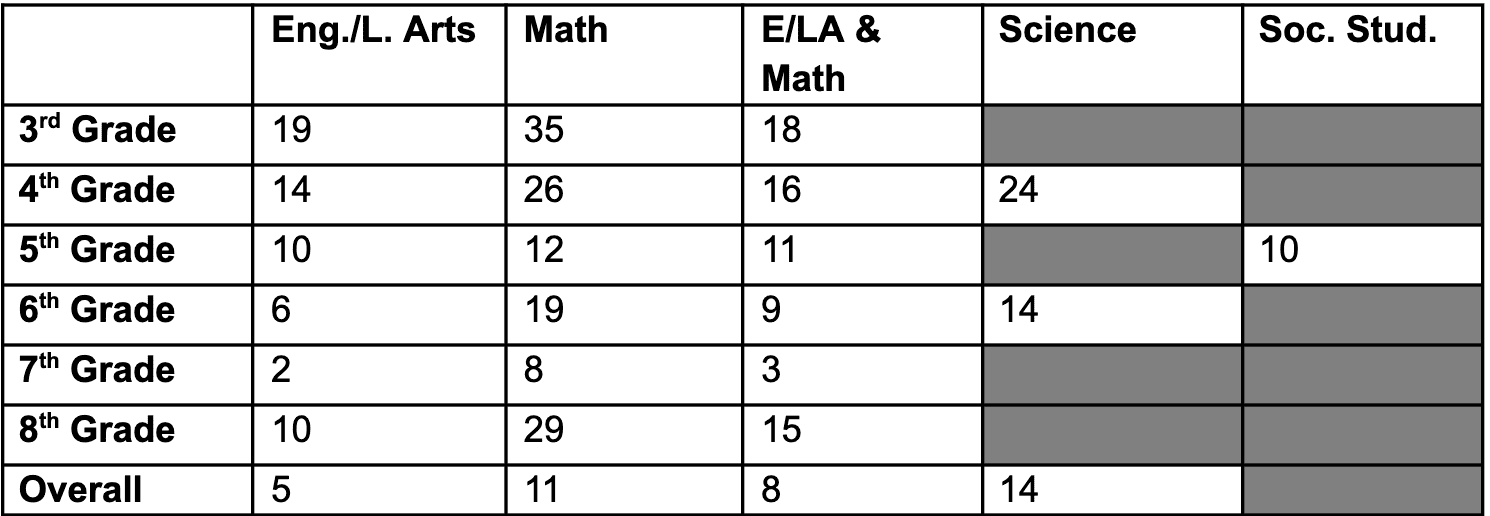
“Overall, DSC ranks fifth in the state for English/Language Arts, eleventh in Math, and eighth in ELA/Math combined.
“Accountability at the high school level is focused on SAT testing. Qualifying students are required to take the SAT for accountability purposes, regardless of their post-secondary plans. The SAT is made up of two scoreable sections: Evidence-Based Reading and Writing (EBRW) and Mathematics. CHS has experienced significant increases in both testing areas. EBRW and Math scores are among the best in the state, with EBRW scores increasing more than 10 points in the past two years and Math increasing more than seven points. These are significant increases over a relatively short period of time.
“CHS is also a state leader in dual credit attainment. Last school year, CHS students earned 16,165 college credits, with over 120 students completing at least one full year of college courses while attending high school. The savings this provides DSC families is staggering. Those 16,165 credits equate to a savings of $4,687,850 in just one year!
“DSC’s online option—Northwest Indiana Online School (NWIOS)—is also doing an excellent job academically compared with other online schools in Indiana. NWIOS ranks third in the state on accountability metrics for English/Language Arts and fourth in the state for Mathematics compared to their online counterparts.
“Our students, teachers, and staff have made tremendous progress over the past several years. We will continue to work extremely hard to improve the education we provide our students each and every day.
“This December, the Indiana Department of Education will be releasing new A-F grades for all Indiana schools. School grades have not been assigned since 2019. The new grade indicators will allow DSC schools to assess our progress on a variety of indicators established by the state. We are cautiously optimistic that our schools will fare well with the new ratings. Our team will carefully analyze the results and develop plans to address any areas where we see opportunities for improvement. Once grades are released, we will share them with our community through school newsletters, social media, and the DuneNews.
“HOW DSC ADMINISTRATION DETERMINES WEATHER DELAYS AND CANCELLATIONS
“As the season for inclement weather approaches, have you ever
wondered how DSC makes decisions about delays and cancellations?
“When determining whether to delay or cancel school, our top priority is student safety. Duneland School Corporation (DSC) officials monitor weather forecasts and road conditions whenever conditions warrant. This includes having employees inspect DSC roads and campuses as early as possible.
“DSC also communicates directly with the Porter County Highway Department. Rural roads can be particularly challenging because of the number of miles that must be cleared and the potential for blowing snow. Visibility can also be reduced in rural areas when fog develops.
“Several factors are considered before a decision is made to delay or cancel school. These factors are evaluated together and are not listed in order of priority:
“1. Road conditions: Whether roads are safe for DSC buses and other
transportation users, including parents, students, and staff.
transportation users, including parents, students, and staff.
“2. Pedestrian safety: Whether students can safely walk to school, travel to bus
stops, and enter school buildings.
stops, and enter school buildings.
“3. Wind chill: Whether temperatures create hazardous conditions for students
who must be outside for extended periods (bus stops or walkers), typically
when the wind chill reaches or falls below -20°F.
who must be outside for extended periods (bus stops or walkers), typically
when the wind chill reaches or falls below -20°F.
“4. Vehicle and equipment operation: Whether temperatures allow DSC
vehicles and equipment to operate effectively.
vehicles and equipment to operate effectively.
“5. Weather forecasts: Whether conditions are expected to become so severe
that conducting school would likely be impossible.
that conducting school would likely be impossible.
“6. Travel advisories: Whether government agencies have issued travel
warnings or advisories that affect safe travel.
warnings or advisories that affect safe travel.
“Although Indiana permits schools to use delays and/or eLearning under certain circumstances, DSC prioritizes full-time, in-person instruction whenever it can be conducted safely. As a result, decisions are often made as late as reasonably possible, balancing the need for the most current information with the need to give families adequate time to adjust their schedules.
“WHY A TWO-HOUR DELAY?
“A two-hour delay can provide additional time for road crews to clear roads, for temperatures to rise or fog to lift, and for DSC officials to reassess conditions before students and staff travel to school.
“The two-hour delay also allows the district to preserve the regular school day when conditions improve sufficiently for in-person instruction. Indiana allows schools to use a two-hour delay and still count the day as a full instructional day, provided the required
180 instructional days are met each year.
“ASYNCHRONOUS eLEARNING DAYS
“Currently, DSC designates two asynchronous eLearning days for Election Days.
“On asynchronous eLearning days, students complete assignments independently rather than participating in live instruction. These days provide an alternative to in-person instruction while allowing students to continue their learning. Indiana limits schools to three asynchronous eLearning days per year.
“SYNCHRONOUS eLEARNING DAYS
“When additional eLearning days are needed beyond the district’s designated asynchronous days, DSC uses synchronous eLearning.
“Synchronous eLearning includes live, teacher-directed instruction and interaction with students. The instructional requirements for these days must be met for the day to qualify as a full instructional day under applicable state requirements. Indiana does not limit the number of synchronous eLearning days schools can use.
“BUILT-IN INCLEMENT WEATHER DAYS
“For the past several years, DSC has used synchronous eLearning when inclement weather prevents in-person instruction and a two-hour delay would not adequately address the conditions, rather than utilizing built-in inclement weather days.
“One important consideration is that student attendance on traditional make-up days has historically been very low. In addition, scheduling make-up days presents several challenges. Here are some dates when schools might typically schedule a make-up day:
“*BEFORE OR AFTER WINTER RECESS (DECEMBER AND JANUARY): Northwest Indiana typically experiences fewer severe winter weather events before January, which can make these dates less practical as built-in make-up days.
“*DURING WINTER BREAK (FEBRUARY): The Friday of winter break can be a practical option. However, families and staff have requested a clear deadline for determining when an inclement weather day must be made up. For example, if the designated make-up day is Feb. 14 and school is canceled on Feb. 11, should the make-up day occur just three days later? Alternatively, should the district establish a cutoff date, such as February 1, after which a cancellation would be handled differently? Many people travel during our scheduled breaks, so adding make-up days at the last minute can negatively impact attendance.
“*AT THE END OF THE SCHOOL YEARS: The end of the school year is another logical opportunity to schedule make-up days. However, extending the school year can interfere with graduation plans, family vacations, and other commitments. Historically, attendance on these make-up days has also been poor.
“FINDING THE BEST APPROACH
“There is no perfect solution for addressing inclement weather cancellations. Every approach presents challenges for students, families, and staff. We recognize that not every stakeholder will agree with every decision DSC makes.
“DSC recognizes that eLearning days can be challenging, particularly for families who must balance work schedules, childcare, and students’ learning needs. After considering these factors, the district has determined that eLearning is the most practical approach when weather conditions prevent safe in-person instruction and a delay is not sufficient.
“This approach continues to be reviewed as DSC considers student learning, family needs, staff responsibilities, and the safe operation of our schools. For example, during the 2027-2028 school year, schools will be open on the May Election Day. This will allow us the opportunity to preserve an asynchronous eLearning day that can be used if needed for an inclement weather day.
“We thank the DSC community for its continued support. We appreciate the ongoing collaboration and look forward to continuing to provide the best education possible for our students.
“Sincerely,
Robert McDermott
Superintendent”